"Dice on a grid that clicks, until the board clutters"
About
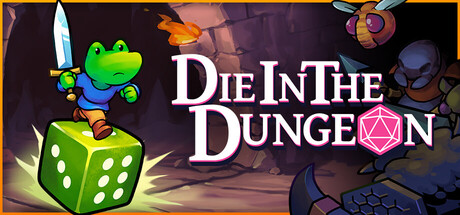
Die in the Dungeon is a turn-based roguelike that swaps the usual card hand for dice. You draw dice each turn and place them on a small grid, where adjacency and stacking decide whether a value attacks, defends, or triggers a relic effect. Relics modify how dice behave, and runs climb through three acts of fights and random encounters toward boss fights with their own objectives. Four classes and difficulty levels up to D8 give the runs structure, with unlocks gated behind repeated play.
Verdict
Die in the Dungeon turns dice placement into a real spatial puzzle, and the moment a multiplied die cascades across the board into a relic chain is where it earns its price. The trouble is legibility: pile two effects onto one tile and the grid turns to mush, and the balance rewards stalling in ways that stretch fights long past their welcome. The art is charming, the unlock pool runs deep, but a few dominant relics narrow the build variety once you know them. For under ten euros it's an easy recommendation to anyone drawn to the grid, just go in knowing the rough edges are real.
You'll like it if …
- +you enjoy arranging pieces on a tight grid and watching adjacency math pay off
- +you want a roguelike deckbuilder that isn't built on cards
- +you don't mind grinding unlocks to reach the wilder combos
You'll dislike it if …
- −cluttered displays and unclear effect stacking frustrate you
- −you want runs that stay brisk and decisive
- −you need varied builds from the start rather than a few standout relics
Breakdown
- +Placing dice on the grid is a genuine spatial puzzle, and multiplying a value before it lands turns a single die into a swing
- +Relic interactions reward setting up the board rather than just playing the best card
- −Stack two effects on one tile and the matrix becomes unreadable, which happens routinely once you build up
- −Heal-and-stall relic loops let runs drag past an hour on simple decisions
- −Some moment-to-moment choices feel arbitrary rather than considered
- +The volume of dice and relics unlocked over time opens up combos that genuinely break encounters
- +Four classes and the D1-D8 difficulty ladder give long-term reasons to keep climbing
- −Mid-run dice rewards are often weak, leaving little to build toward between relics
- −A handful of overpowered relics flatten build variety, and some players hit a wall of repetitive combats with thin dice synergy
- +The frog cast and small encounter moments carry a light charm without pretending to be a story
- −There is no real narrative here, which is fine for the format but worth knowing
- +The pixel art and character design are widely called adorable, and the look holds together
- +Enemy and relic designs give the dungeon personality
- −The same pixel style hurts legibility of text and symbols, especially at small sizes
- −Enemy animations can read as muddy, and UI elements overlap
- +Stable and polished for the price, with no game-breaking bugs reported across long playtimes
- −Relics overlap buttons and several effects, like the top hat, fire with no in-game explanation
- −Translation passages occasionally need a second read to parse
score