"A tender co-op wander, if the audio mixer relents"
About
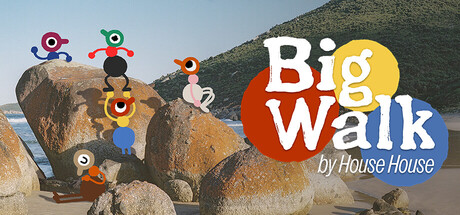
Big Walk is an online co-op adventure from House House, the studio behind Untitled Goose Game. Up to twelve friends roam a large Australian wilderness together, solving environmental puzzles and reaching objectives that lean on communication rather than combat. The tools are the point: proximity voice chat, walkie talkies, flare guns, binoculars, a helmet that blinds the wearer so a partner has to guide them. A single big map holds roughly fifteen hours of exploration, with puzzles built around coordinating over distance and improvising signals when talking isn't an option.
Verdict
There's a lovely, generous game here about crossing a landscape with people you like, and the puzzles that make you guide a blindfolded friend or radio directions across a ridge are House House at its most charming. The single map limits how long that charm lasts, but the harder problem is technical: with no way to balance voice chat against the roar of grass and lanterns, the central act of hearing your friends becomes a chore of volume juggling. Fix that slider and the missing accessibility toggles and this jumps a full grade. As it stands, gather the right group and it rewards you, just go in knowing the audio will fight you first.
You'll like it if …
- +You have a regular group of friends and want a calm, non-competitive world to wander together
- +You enjoy puzzles that make you invent your own signals and shorthand
- +Atmosphere and quiet company matter more to you than plot or challenge
You'll dislike it if …
- −You want a game with solo value or lasting replayability on a single map
- −Fiddly audio setup and missing accessibility options will sour the mood before you start
- −You need an explicit story to stay invested
Breakdown
- +The puzzles push you toward inventive communication, from hand gestures to walkie-talkie relays, instead of just talking through a solution
- +Non-violent cooperation carries the whole loop, and improvising a workaround with a friend is where the game comes alive
- +Tools like the blind helmet force one player to trust another's directions, turning a puzzle into a real back-and-forth
- −Puzzle difficulty skews light and predictable once you learn the vocabulary
- −Physical climbing can turn fiddly and frustrate more than it challenges
- +Fifteen-plus hours across one map, with puzzles that reward creative use of the toolkit
- +Emergent moments crop up when a party splits and coordinates over radio
- −Everything sits on a single map, so once it's walked there's little reason to return
- −It only works with friends online, and post-completion content is thin to nonexistent
- −Replay value is a genuine open question for solo-minded players
- +Worldbuilding lands through environment and mood rather than exposition, and it reads as tender rather than empty
- +The wilderness carries real emotional weight for players separated by distance, from beach sunrises to shared stargazing
- −There is no explicit story spine, so players wanting plot and characters will find little to hold
- +Sound effects and animation show unusual care, from windswept grass to the small tool interactions
- +The art direction is warm and colourful, and the Australian setting feels lived-in
- −No separate slider for voice chat versus game and environment audio, so teammates are barely audible unless you crank everything to a deafening level
- −A voice activation delay makes talking to distant friends stutter and lag
- −Aliasing, minor graphical glitches and inconsistent framerate show up regularly
- +Runs cleanly on Linux via Proton, and multiplayer connection is mostly seamless
- +Menus are easy to move through
- −Accessibility is bare: no brightness slider, no head-bob toggle, no text size options, no framerate limiter beyond v-sync
- −Reconnecting after a mid-session drop can fail entirely, with lobby codes and friend invites not showing up
- −Some reviewers report crashes severe enough to knock out their GPU
- −The main menu music blares far louder than it should
score