"Wire a ship to land itself, past a tutorial that won't help"
About
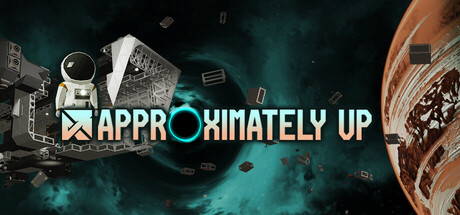
Approximately Up is a physics-based space sandbox where you assemble a spaceship bolt by bolt on a launch pad, then fly it across twelve planets to complete delivery and fetch missions. The building sits somewhere between Kerbal Space Program and Space Engineers: you mount thrusters, run cables, wire battery banks, and can drop into logic circuits deep enough to program auto-landing, hover, and automatic braking yourself. Flight is fully simulated, so a lopsided thruster layout or a snapped cable changes how the craft handles. You can play solo or bring a crew into co-op, where missions turn into shared engineering and shared blame. There is no story: structure comes from missions and the workshop, where players trade blueprints.
Verdict
Approximately Up is a sandbox that trusts you to earn its rewards, and when a hand-wired ship touches down on its own, that trust pays off handsomely. The building goes as deep as you're willing to chase, from a quick patch-job to a self-flying machine held together by logic circuits and math. The problem is everything before the payoff: a tutorial that abandons you, a build interface with hidden collision boxes and no undo, and a full restart every time a mission repair isn't allowed. Push through that wall and there's a remarkable engineering toy here. Just know the wall is real, and no controller will help you over it.
You'll like it if …
- +You want to spend ten hours wiring a self-landing ship and call that the fun part
- +You enjoy figuring out systems the game refuses to explain
- +You have a crew to bring into co-op and don't mind arguing mid-flight
You'll dislike it if …
- −You need a story or any sense of direction beyond missions you set yourself
- −Being sent back to a full restart after one failed part will sour you
- −You expect a tutorial to teach the basics before it drops you in
Breakdown
- +The design-launch-iterate loop rewards patience: getting a logic circuit to handle its own landing and hover lands as a genuine engineering win
- +Physics-based flight makes every thruster placement and cable route matter, so a working ship feels earned rather than handed to you
- +Co-op turns a routine delivery into improvised chaos, with crews arguing over who bolted the reactor on backwards
- −No mid-mission repairs means a single failure sends you back to a full restart, which stings after a long build
- −The flight model can feel like several aircraft fighting each other, and new pilots struggle to read what the ship is doing
- −Deliberately omitted accessibility options push the barrier to entry higher than it needs to be
- +Logic circuits and math components open a ceiling most sandboxes never reach: self-flying ships are actually buildable
- +Twelve planets and procedural missions keep supplying new problems, with players reporting 100+ hours before the full release
- +Workshop blueprint sharing lets you study other people's automation or bolt it onto your own designs
- −Components gated behind missions can leave you feeling fenced off from the parts you want
- −The systems intimidate: much of the depth is invisible until you go digging for it
- +Environmental touches carry some atmosphere, like the horror hints on the dark side of a moon
- −No story, dialogue, or arc at all, so the fetch-and-deliver missions are pure scaffolding
- −Anyone wanting direction beyond self-set engineering goals will find nothing to hold on to
- +The spectacle of a ship coming apart under bad physics is a reliable payoff
- +Strong technical footing for an indie, and it runs cleanly on Linux
- −Post-release camera stutter on planets drops a 240+ FPS baseline to 40-50 on every turn
- +Stable post-launch, with crashes rarely mentioned
- −The tutorial drops you into a doomed uncontrolled ship and explains almost nothing about inventory, hotbars, or cable routing
- −The build interface hides invisible collision boxes on angled pieces, making precise placement fiddly
- −No undo, no copy tool, and no variation wheel for block sizes, so building leans on hotbar juggling
- −No controller support at launch despite the flight focus
score