"Building up a cliff shines, until the save bug bites"
About
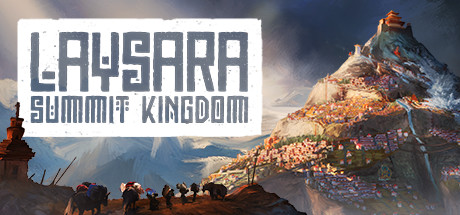
Laysara: Summit Kingdom is a city builder set on steep Himalayan peaks, where flat ground is scarce and every terrace has to earn its place. You settle three castes with different needs (lowlanders who grow tsampa grain, artisans who craft, and monks who tend a temple at the summit) and wire their production chains together while yaks haul goods along walker routes up the slopes. Weather breakdowns and avalanches threaten the settlements you carve into the rock. The game runs in real time with pause, and buildings go up instantly, so the challenge is layout and logistics rather than construction time. It ships in Early Access with a 13-mission campaign plus sandbox and scenario modes and trade routes that link separate mountains.
Verdict
Laysara: Summit Kingdom has a hook most city builders can't claim: building up a cliff instead of across a plain, with the temple crowning the peak. When the terrain-as-puzzle idea is working, in the first hours of a level, it's quietly satisfying. Then the late game asks you to demolish and rebuild the same terraces over and over, and the absence of mass upgrades, building rotation and a safe save system turns that grind into a chore. There's a very good management game buried in here, but in this Early Access state the missing tools and the save-overwrite bug decide how far you'll get.
You'll like it if …
- +You enjoy slow, deliberate layout puzzles where limited space is the whole point
- +A striking, underused setting matters more to you than deep economic systems
- +You accept Early Access rough edges in exchange for a fresh idea
You'll dislike it if …
- −You want the systemic depth of a mature colony sim
- −Repetitive manual clicking and missing bulk tools wear you down fast
- −Losing progress to a save bug is a dealbreaker
Breakdown
- +The early game reads like a spatial puzzle: fitting production onto limited ledges gives each placement weight
- +Vertical terrain forces layout decisions most flat-map builders never ask for
- −The late game turns into constant teardown and reshuffle of things you already built, which drains the puzzle feeling
- −The economy can spiral into unrecoverable death states that punish rather than teach
- −With instant building and free pausing, the loop flattens into pause, place, wait for money, repeat
- +Reviewers put its production chains a notch above lighter fare like Elvenar
- +The three-caste needs give you several plates to keep spinning at once
- −Systems stay simple next to genre heavyweights, with little long-term strategic branching
- −Fixed campaign levels and a thin sandbox limit reasons to replay
- +The Tibetan-inspired setting is a fresh backdrop for the genre and carries real charm
- +Short dialogue and inter-settlement trade give the campaign a light thread
- −Worldbuilding stays sparse, so the theme decorates more than it drives
- +Consistently praised visuals: colourful, detailed voxel mountainsides that stay legible
- +Villagers carry individual item models as they cross the village, a warm touch that sells the economy
- +A calming soundtrack that suits the slow planning
- −Audio is pleasant but forgettable, sitting in the background rather than shaping mood
- +Some mass-resource pointing tools exist and hint at the quality-of-life the game needs more of
- −No mass placement or bulk upgrade: clicking sixteen buildings one by one is a common breaking point
- −A save system that overwrites old files without warning can wipe whole levels of progress
- −Missing restart-mission option leaves players softlocked
- −Reports of crashes on loading screens
- −Onboarding leaves resource distribution and building rules unexplained
- −No building rotation and one-way connections complicate every layout
score