"Weighty arcade combat undercut by no rebinding and an ear-stabbing bug"
About
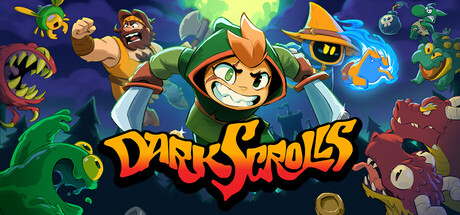
Dark Scrolls is a 2D action platformer that borrows the forced auto-scroll of arcade shmups and wraps it in roguelite runs. You pick one of three heroes, Griz the barbarian, Pigeon the thief, or Emeris the mage, and fight through side-scrolling levels that push the screen forward whether you're ready or not. Combat runs on a double-jump attack, positioning, and crowd control, with a star meter feeding into perks and several currencies (coins, diamonds, crystals) unlocking characters and upgrades. Bosses sit at the end of branching paths, and the whole thing plays solo or in local and online co-op. The nods to Ghosts 'n Goblins are worn openly.
Verdict
There's a good arcade platformer buried in Dark Scrolls, and the moment-to-moment fighting, when the barbarian isn't cheating the difficulty away, has weight and character. The trouble is everything around it. The audio bug that spikes your ears after every line of dialogue, the total absence of control rebinding, the missing onboarding for systems that badly need it, and the run variety that dries up fast all pull in the same direction. It plays like a launch that arrived a patch cycle early. Wait for the fixes, or come in knowing you'll be fighting the packaging as much as the enemies.
You'll like it if …
- +You want a short, spiky arcade platformer to run again and again with a friend on the couch
- +You enjoy learning combat through positioning and crowd control rather than a tutorial
- +Retro Ghosts 'n Goblins-style challenge is the appeal, not a turn-off
You'll dislike it if …
- −You need to remap controls before you'll touch a game
- −Shallow between-run progression makes roguelites feel pointless to you
- −Loud, unfixable sound effects are enough to make you quit
Breakdown
- +The double-jump attack has real weight, and you keep facing one direction while slowing as you swing, which makes positioning matter
- +The auto-scroll is built into the challenge rather than bolted on, pushing you to manage crowds instead of just platforming
- +Three heroes play distinctly enough that switching changes how you approach a level
- −Controls tip into floaty and slippery, so missed landings feel like the game's fault rather than yours
- −The barbarian's invincibility frames trivialise fights other characters have to sweat through
- −The relentless scroll can shove you into hits that read as unfair rather than earned
- +Character unlocks and perk combinations give a reason to start over
- +Co-op broadens the appeal for players who want a partner alongside them
- −Runs repeat quickly, with level layouts that stop surprising you
- −Between-run progression is thin, so the roguelite loop rarely feels like it's building toward anything
- −Perk and currency systems stay opaque, and they don't reward you for thinking ahead
- +The revenge-after-betrayal setup gives the three heroes a light hook and some personality in their design
- −Story is barely present and never becomes a reason to keep playing
- +Pixel art is lively and detailed, clearly made with care
- +The chiptune soundtrack is energetic and suits the arcade pacing
- +Combat is dense with beeps and pops that make each hit feel loud and immediate
- −A piercing noise fires every time an NPC finishes a line, and it stabs at the ears
- −The volume slider doesn't touch several loud sound effects, so you can't turn the worst of it down
- −Occasional visual glitches, and some players find the cartoony style goofy rather than striking
- +The art and audio direction land as a coherent, heartfelt package when the bugs stay quiet
- −No control rebinding at all, a flat dealbreaker for many on the fixed Z/X/C layout
- −No tutorial or onboarding despite systems that need explaining
- −No mid-run saving, so a long attempt is all or nothing
- −Awkward menu navigation, rough hitboxes, and weak localization compound the unfinished feel
score